Bioactive peptides

More mobile joints. Built from within.

Not by supplying collagen. By activating your cartilage cells.

The protocol

One daily signal.
Two routes: powder or capsules.

Two formats. One effect.
The routine changes. The signal does not.

Collagen Powder for Joints and Cartilage

One scoop in water. Neutral in taste. Fits into any morning routine.

5 gper serving

Collagen Capsules for Joints and Cartilage

4 capsules daily. No preparation. Fits in any bag — for on the go.

2.5 gper serving

The body needs regular intake.

The format is your choice.

Why collagen for joints & cartilage?

Cartilage needs collagen

Collagen makes up about 70% of the dry matter of cartilage tissue — it forms the structural basis for firmness, elasticity and mobility. From the age of 30, the body’s own collagen production in cartilage declines. The result: joints become stiffer, movement more painful.

Joint pain — a widespread burden

Aching joints are one of the most common complaints there is. The wearing down of cartilage tissue is a natural part of ageing — but it often leads people to avoid movement. Yet moving is how cartilage gets its nutrients. Bioactive peptides support the cartilage cells in breaking that cycle — from within, step by step, measurable after 10–12 weeks.

Movement as the key

Cartilage has no blood supply of its own — it is supplied with fluid and nutrients through movement. Regular, gentle movement is therefore what keeps joints healthy. Enough collagen production helps cartilage cope with strain and recover.

Choose your protocol

Not extra collagen.The right signal.

Taken daily. Effective long term.

Powder for your daily routine. Capsules for on the go.

30
Days
First signs

Start of the protocol

Start of the protocol

Single
34,95 €
30-day guarantee
180
Days
Structural strength

Effects that build month by month

Effects that build month by month

6 pack
129,95 €
21,65 € / month· Save 45%
Free shipping 30-day guarantee
30
Days
First signs

Start of the protocol

Start of the protocol

Single
34,95 €
30-day guarantee
180
Days
Structural strength

Effects that build month by month

Effects that build month by month

6 pack
129,95 €
21,65 € / month
Free shipping 30-day guarantee

The science behind collagen for joints and cartilage

Bioactive peptides vs. ordinary collagen

Not all collagen products are the same. Our peptides are produced by carefully controlled enzymatic hydrolysis — the collagen is broken down into particularly small, specific fragments. These small peptides are absorbed by the body and travel directly to the cells — where they do not just act as building material — they send signals. That signal is exactly what our peptides are made for.

How the signal arises

Once absorbed, the peptides travel through the bloodstream to the cartilage cells — the cells that build the structure of cartilage tissue. There they act in two ways: they supply amino acids as building blocks, and they stimulate the cells directly to build new cartilage tissue. The result: the body’s own collagen metabolism in cartilage is stimulated — from within.

Cartilage cells — the cells that matter

Cartilage cells are specialised cells in cartilage tissue. Their job: to build and maintain the extracellular matrix of the cartilage — made up of collagen, proteoglycans and water. They determine how firm, flexible and mobile your joints are. When cartilage cells receive the right signal, they actively build new tissue — that is the heart of our protocol.

The extracellular matrix (ECM)

The ECM of cartilage is the network of proteins and molecules that gives cells structure and support — made up of collagen, proteoglycans and water. It determines the compressive strength and elasticity of the cartilage. Bioactive peptides support the ECM by telling cartilage cells to renew it — the signal comes from outside, the effect happens inside.

Why collagen for joints & cartilage from Kollagen Institut?

Clinically studied

Our peptides have been tested in peer-reviewed studies — not with a similar product, but with exactly the raw material we use.

In clinical studies, participants showed −40% less knee pain during sport after 12 weeks (Freiburg 2021, n=180) and −38% less knee pain in an independent study after 12 weeks (Freiburg 2017, n=139).

For active people and recovery

Athletes put their joints under a lot of strain — collagen helps the cartilage cells cope with that strain and recover after training. Enough collagen production also plays an important part in healing after injury or orthopaedic surgery.

Quality from Germany

Our joint collagen is manufactured exclusively in Germany and laboratory-tested for purity. The raw material comes from Europe — traceable and certified.

We deliberately leave out additives, colourings, preservatives and sweeteners. With a 30-day money-back guarantee.

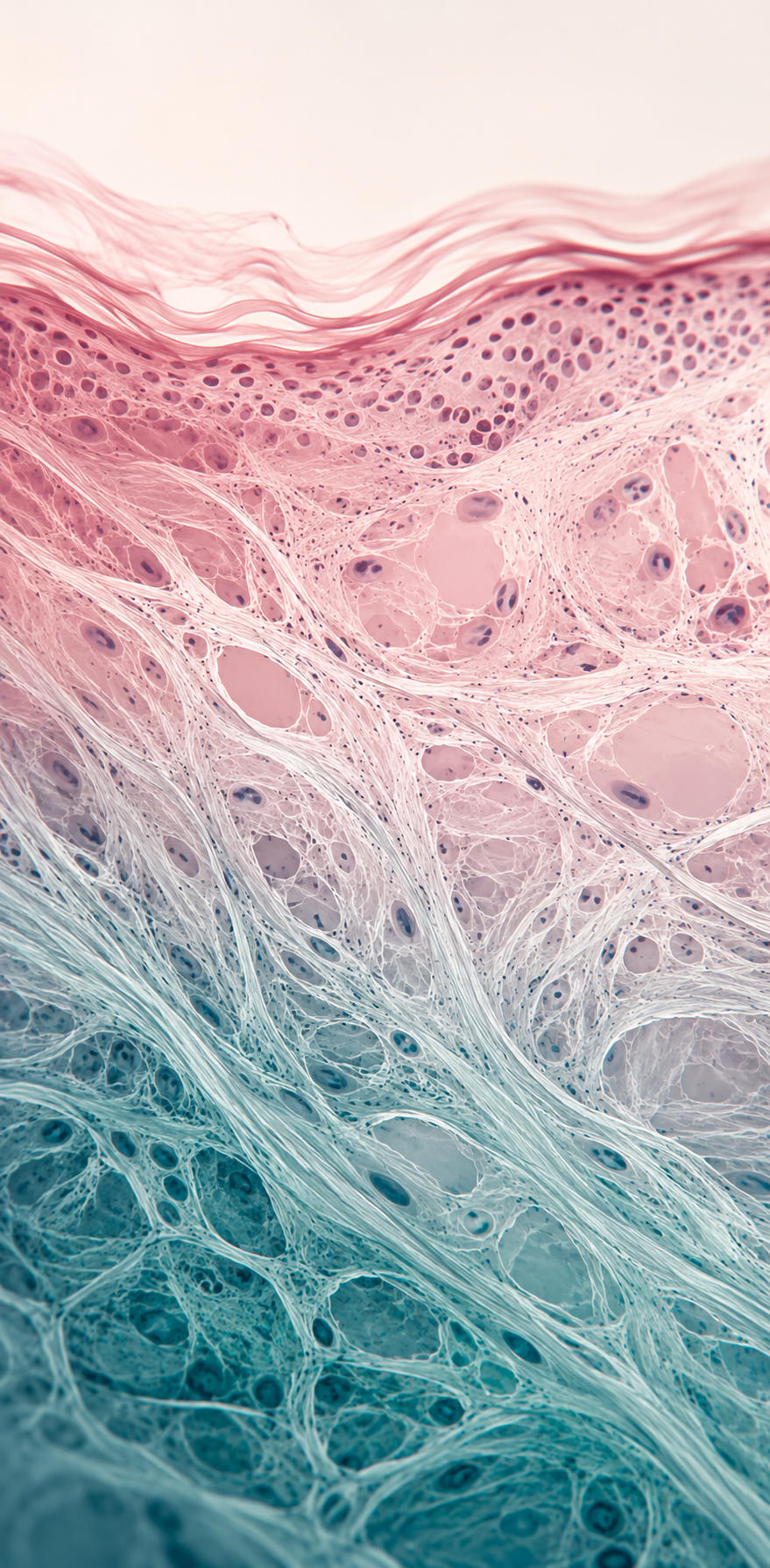
Stained micrograph of human connective tissue — dermal collagen fibres in cross-section

Connective tissue · stained micrograph
Schema 04.1

Why the right peptides matter

More collagen is not the goal.
What the body does with it is.

When you take ordinary collagen, it is broken down during digestion — like any other protein. It never reaches the places where it is meant to work.

Our peptides are smaller and more specific: they are absorbed by the body and travel through the bloodstream directly to the cartilage cells — the cells that build joints and cartilage from within. There they send a signal: the prompt to form new cartilage tissue and maintain existing cartilage. Not supply. Activation.

The body already knows how to renew itself.
The question is whether it gets the right signal.

Scientifically documented.

Study: reduction in knee pain

Study: „Improvement of activity-related knee joint discomfort following supplementation of specific collagen peptides"

Authors: Denise Zdzieblik, Steffen Oesser, Albert Gollhofer, Daniel König

Published in: Applied Physiology, Nutrition, and Metabolism

Publication date: June 2017

Participants: 139

Duration: 12 weeks

Results and conclusions: The study showed that supplementation with specific collagen peptides led to a statistically significant improvement in activity-related joint pain — −38% less knee pain during sport after 12 weeks vs. placebo.

Link: https://t.ly/pr1dm

Study: reduction in knee pain — follow-up study

Study: „The Influence of Specific Bioactive Collagen Peptides on Knee Joint Discomfort in Young Physically Active Adults: A Randomized Controlled Trial"

Authors: Denise Zdzieblik, Judith Brame, Steffen Oesser, Albert Gollhofer, Daniel König

Published in: Nutrients (MDPI)

Publication date: 5 February 2021

Participants: 180

Duration: 12 weeks

Results and conclusions: The study showed that supplementation with specific bioactive collagen peptides led to a statistically significant improvement in activity-related joint discomfort in physically active young adults — −40% less knee pain during sport after 12 weeks vs. placebo.

Link: https://t.ly/yh9N0

Study: improvement in cartilage tissue

Study: „Change in knee osteoarthritis cartilage detected by delayed gadolinium enhanced magnetic resonance imaging following treatment with collagen hydrolysate: a pilot randomized controlled trial"

Authors: T.E. McAlindon, M. Nuite, N. Krishnan, R. Ruthazer, L.L. Price, D. Burstein, J. Griffith, K. Flechsenhar

Published in: Osteoarthritis and Cartilage

Publication date: 17 February 2011

Participants: 30

Duration: 24 weeks

Results and conclusions: Using MRI analysis, the study showed a statistically significant increase in proteoglycan density in cartilage tissue in the patients treated with collagen hydrolysate compared with the placebo group. Oral intake of collagen hydrolysate had a direct influence on human cartilage tissue.

Link: https://t.ly/qulhG

More about joints & cartilage

The 10 best foods packed with collagen

Collagen is a key part of joint health. You can take in collagen not only through supplements but also through "ordinary" food. Here you will find out which foods are packed with collagen!

Read now

The best collagen types for your joint health

We explain what collagen means for joint health and how its decline with age can lead to discomfort. We look at the different collagen types and their benefits, along with the effect of collagen as a supplement on the joints. We also show natural measures for joint health.

Read now

Signs of a collagen deficiency

Collagen is the most important protein in the body’s connective tissue. As we age, the body’s own collagen production declines. Find out here the signs of a collagen deficiency and what you can do about it.

Read now
gefaltete Hände

Collagen loss with age

What happens to your body’s own collagen as you get older? Find out more about the natural loss of collagen with age and its effects on skin and tissue.

We look at the causes and mechanisms of collagen loss in ageing skin and show effective methods of regeneration, to slow the ageing process and improve skin structure.

Read now

Chondrocytes, collagen and joint health

In this article we explain the link between chondrocytes and collagen and what they mean for the health of the joints. We look at collagen as a supplement for joint health and the current state of the scientific evidence. Finally we give a recommendation for joint collagen.

Read now

Your questions. Our answers.

What is collagen?

Collagen is the most abundant structural protein in the human body — responsible for the firmness of skin, hair, nails, tendons, cartilage and bones. From the age of 30, the body’s own collagen production in cartilage declines — noticeable as joint stiffness and restricted movement.

Why supplement collagen?

As we age, the body’s own collagen production declines. From the age of 30, the amount of collagen in cartilage tissue falls. The result: joints become less resilient, movement more painful.

Why collagen for joints and cartilage?

Bioactive peptides send signals to the cartilage cells — the cells that build and maintain cartilage tissue. The result: joints become more mobile, cartilage structurally stronger. Not because collagen is supplied — but because the body is prompted to rebuild it itself.

Why collagen from Kollagen Institut?

Our peptides are the same ones used in peer-reviewed studies — not similar, but identical raw materials. Clinically studied, produced in Germany, with no additives or preservatives. And with a 30-day money-back guarantee.

How do I take the joint collagen?

As a powder: stir one scoop (5 g) daily into water, juice or a drink of your choice — neutral in taste, no preparation.
As capsules: 4 capsules daily with a glass of water. Both formats contain 30 servings — one month of the protocol.